Lake Life on Your Own Terms: How Tsuchiura Is Quietly Becoming the Go-To Spot for Recreational Water Athletes
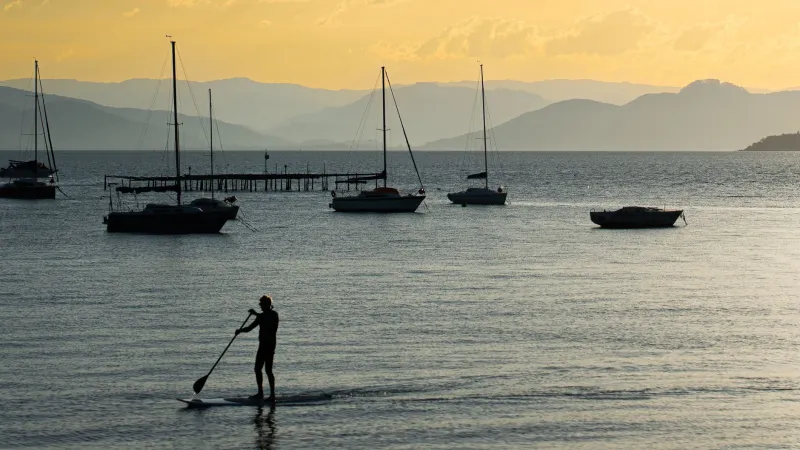
There's a moment that almost every person who shows up to Lake Kasumigaura for the first time describes in nearly the same way. You walk down to the water's edge, look out across what feels like an inland sea stretching toward the horizon, and think: where is everyone?
For athletes used to jostling for lane space at crowded pools or dodging jet skis on overrun American lakes, that emptiness isn't a red flag. It's the whole point.
Tsuchiura has long had a reputation among serious cyclists and competitive kayakers — people who come here with training plans and race goals. But a quieter, arguably more interesting story is unfolding alongside that one. Recreational athletes — the stand-up paddleboarders, the open-water swimmers, the casual kayakers who paddle more for the view than the split times — are finding their way here too. And a lot of them aren't leaving anytime soon.
The Lake That Doesn't Intimidate You
Lake Kasumigaura is the second-largest lake in Japan, covering roughly 67 square miles. That scale sounds serious, and in some ways it is. But what makes it work for recreational athletes is that it doesn't feel serious when you're on it.
The shoreline near Tsuchiura is accessible, calm on most days, and — critically — not overrun with the kind of boat traffic that turns a peaceful paddle into a survival exercise. There are no weekend armadas of speedboats churning up the water. No crowded launch ramps with hour-long waits. You show up, you get on the water, and you do your thing.
Marcus, a 34-year-old from Portland who relocated to Japan for work about two years ago, started stand-up paddleboarding on the lake after a coworker mentioned it almost as an afterthought. "I'd been doing SUP back home for a few years, but it always felt like you were performing somehow," he says. "Instagram spots, crowded rental beaches, people watching. Out here, it's just you and the water and maybe a few egrets. It genuinely changed how I feel about the sport."
He's out on the lake two or three mornings a week now, usually before work. He doesn't track his sessions. He doesn't post most of them. "It's become almost meditative," he says. "I didn't expect that."
A Spectrum of Skill, All Welcome
What's interesting about Tsuchiura's emerging water culture is how many different types of athletes it seems to accommodate at once — without any of them getting in each other's way.
On one end of the spectrum, you've got competitive open-water swimmers doing serious distance work. The lake's relatively calm surface and lack of heavy chop makes it a genuinely useful training environment, and a handful of swimmers who compete in triathlons or open-water events have started using it as a regular practice venue.
On the other end, you've got people like Diane, a 52-year-old American expat who describes her relationship with water sports as "enthusiastic beginner, always." She picked up kayaking after moving to the area and has been exploring the lake's edges on weekends for the past year. "I'm not fast. I'm not training for anything. I just love being out there," she says. "There's no one making me feel like I'm doing it wrong, which — honestly? — hasn't always been my experience with sports."
That lack of hierarchy feels significant. In a lot of athletic communities, there's an unspoken pressure to perform or progress at a certain rate. Tsuchiura's water scene, still small enough to be genuinely informal, doesn't seem to have developed that culture yet. People help each other out, share gear tips, point each other toward good launch spots. It has the feel of a community that hasn't yet calcified into cliques.
The Gear Situation Is Better Than You'd Think
One of the practical hurdles for anyone wanting to get on the water in a new place is equipment. Traveling with a paddleboard or a kayak isn't exactly convenient, and buying gear in a foreign country can feel daunting if you're not confident in the language.
Tsuchiura has quietly developed a small but functional ecosystem around water sports access. There are rental options near the lake, local shops where staff are increasingly used to fielding questions from English-speaking visitors, and a growing informal network of athletes who are happy to point newcomers in the right direction.
For longer-term visitors or residents, the secondhand market for water sports gear in the area is worth exploring. Japan's general culture of taking good care of belongings means used equipment often comes in excellent condition, and prices tend to be reasonable.
The Lifestyle Pull
Talk to enough people who've spent serious time on Lake Kasumigaura and a pattern emerges: they came for the water, but they stayed for everything around it.
Tsuchiura is a real city — not a resort town, not a tourist trap — with good food, genuine neighborhoods, and a pace of life that feels sustainable in a way that Tokyo simply doesn't. For athletes who want to structure their lives around training and recovery rather than commuting and performance, that combination turns out to be pretty compelling.
"I've done the thing where you live in a city and try to fit your sport into the margins," says Marcus. "Getting up at 5 AM to drive an hour to a decent lake, squeezing in an hour on the water, driving back, being exhausted all day. Here, the lake is just... there. It's part of the rhythm."
Diane puts it more simply: "I feel healthier here than I have in years. And I think a big part of that is just having water I can get to easily, whenever I want."
Finding Your Entry Point
If you're a recreational athlete thinking about spending time in Tsuchiura — whether that's a week-long visit or something longer — the lake is genuinely easy to access. The waterfront area near the city center is walkable from most accommodation options, and the surrounding shoreline offers plenty of room to explore once you get your bearings.
Beginner-friendly conditions are the norm rather than the exception, especially in the calmer morning hours. If you've been wanting to try stand-up paddleboarding, open-water swimming, or recreational kayaking in a low-pressure environment, this is a pretty ideal place to do it.
And if you're already an experienced water athlete looking for a change of scenery — somewhere that gives you quality time on the water without the crowds, the noise, or the sense that you're constantly being evaluated — Tsuchiura might be the reset you didn't know you were looking for.
The lake is right there. It's not waiting for you to be ready. It's just waiting.